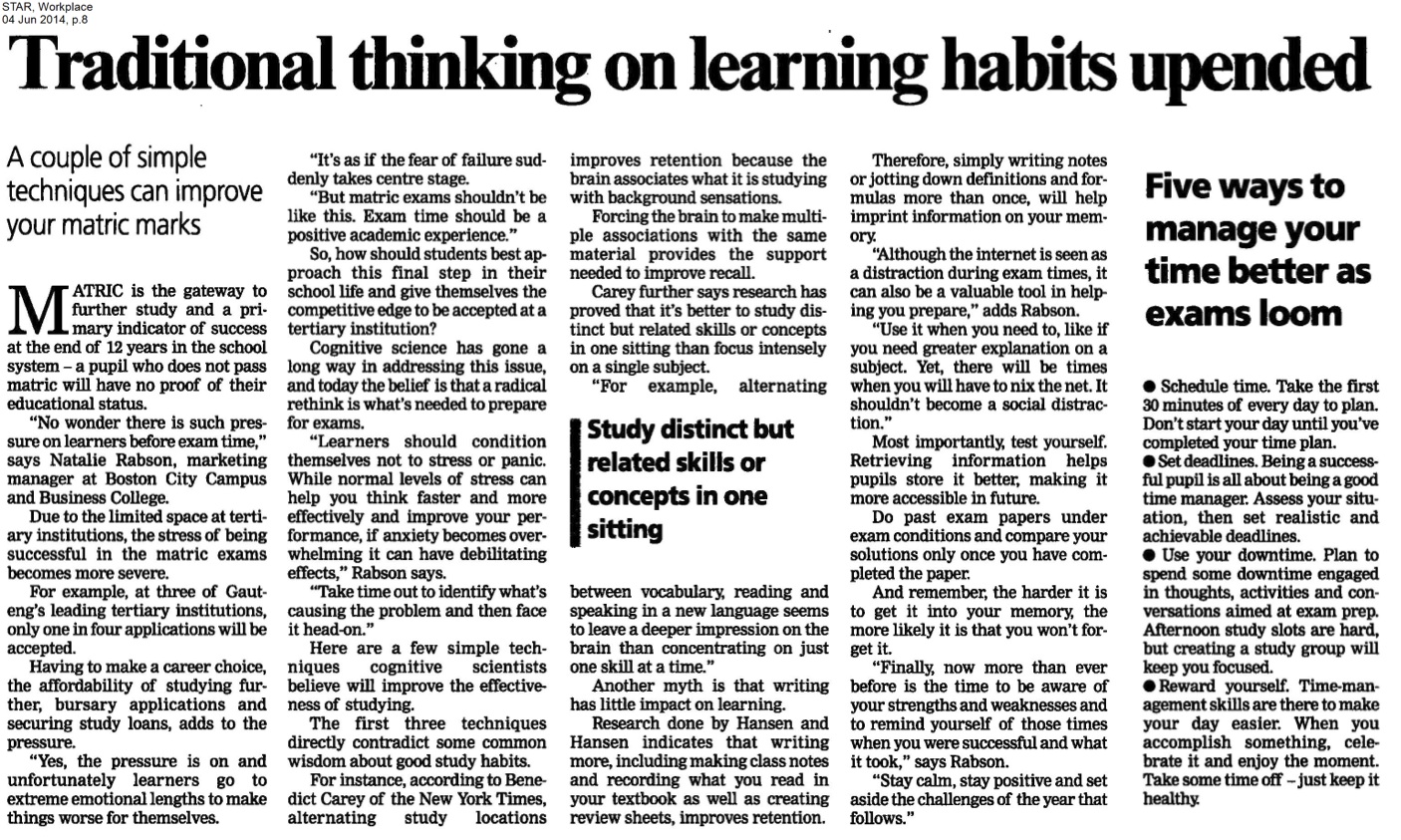
“Matric is the gateway to further study and a primary indicator of success at the end of 12 gruelling years within the school system – a student who does not pass matric will have no proof of their educational status. No wonder there is such pressure on learners before exam time,” says Natalie Rabson, Marketing Manager at Boston City Campus & Business College.
Due to limited space available at tertiary institutions, the stress of being successful in the matric exams becomes more severe. For example, at three of Gauteng’s leading institutions only one in four applications will be accepted. Having to make a career choice, the affordability of studying further, bursary applications and securing study loans, also adds to the pressure.
“Yes the pressure is on and unfortunately learners go to extreme emotional lengths to make things worse for themselves. It’s as if the fear of failure suddenly takes centre stage. But matric exams shouldn’t be like this – exam time should be a positive academic experience,” says Rabson.
So, how does one best approach this final step in one’s school life and give oneself the competitive edge to be accepted at a tertiary institution?
Cognitive science has gone a long way in addressing this issue and today the belief is that a radical rethink is what’s needed to prepare for exams.
”Learners should condition themselves not to stress or panic. “Whilst normal levels of stress can help you think faster and more effectively and improve your performance, if anxiety becomes overwhelming it can have debilitating effects. It’s therefore important to take time out to identify what’s causing the problem and then to face it head on,” says Rabson.
Only then can one make use of a few simple techniques that cognitive scientists believe will improve the effectiveness of studying. The first three techniques directly contradict some common wisdom about good study habits. For instance, according to Benedict Carey of the New York Times, alternating study locations improves retention. This happens because the brain associates between what it is studying and the background sensations that are occurring. Forcing the brain to make multiple associations with the same material provides the support needed to improve recall of it.
Carey further says that research has proven that it’s better to study distinct but related skills or concepts in one sitting, rather than focusing intensely on a single subject: “For example, alternating between vocabulary, reading and speaking in a new language seems to leave a deeper impression on the brain than does concentrating on just one skill at a time”.
Another myth is that writing has little impact on learning. Research done by Hansen & Hansen indicates that writing more, including making class and textbook reading notes and creating review sheets, will improve retention. Therefore by simply writing notes or jotting down definitions and formulas, more than once will help imprint information in your memory.
“Although the Internet is seen as a distraction during exam times, it can also be a valuable tool in helping you prepare for exams. “Do use it when you need to, like if you need greater explanation on a subject. Yet, there will be times when you will have to nix the ’net. ,” adds Rabson.
Most importantly, continuously test yourself. Retrieving information helps students store the information better, making it more accessible in the future. And remember, the harder it is to get it into your memory, the more likely we won't forget it.
“Finally, now more than ever before is the time to be aware of your strengths and weaknesses and to remind yourself of those times when you were successful and what it took. Stay calm, stay positive and set the challenges of the year that follows aside,” concludes Rabson.
5 Time management tips for exams
Don’t waste time
Prioritising daily activities is the first step to effective time management.
Schedule time to schedule time
Take the first 30 minutes of every day to plan your day. Don't start your day until you complete your time plan.
Set deadlines
Being a successful student is all about being a good time manager. Assess your situation, and then set realistic and achievable deadlines.
Use your downtime
Plan to spend your downtime engaged in thoughts, activities and conversations aimed at exam prep. Often study-related problems are solved not when one is sitting at a desk.
Reward yourself
Time management skills are there to make your day easier. When you accomplish something – celebrate it, and enjoy the moment! Take some time off – just keep it healthy.
Students that apply for admission at Boston City Campus & Business College will get a response to their applications within two working days. And those that apply long in advance for their 2016 studie…
Read more »