High quality tertiary education is a major driver of economic survival and development in an increasingly knowledge-driven global economy. In South Africa during the last decade investment in human capital and, by implication, higher education has moved to the centre stage of strategies to promote economic prosperity, fuller employment and social cohesion. As importantly, recent times have also seen a greater emphasis placed on scarce and critical skills careers and their impact on the economy.
“The relevance of tertiary education for the country’s economy has been overlooked by many in the past. Until literacy and numeracy are adequately addressed by basic education at primary-school level, tertiary education will remain the only way of empowering our nation. Why risk waiting for a new generation to enrich our country when the power of economic growth lies in our immediate hands?” says Mike Thoms, Head of Institution, Boston City Campus & Business College.
Whilst more and more governments and businesses look to tertiary institutions to nurture social and economic growth, it must be understood that such institutions can best accomplish these goals by achieving excellence in their primary mission – the education of their students as the country’s future leaders and innovators in the work market.
According to Natalie Rabson, Marketing Manager at Boston City Campus & Business College, for a higher education institution to be successful in achieving this, it needs to rely on a combination of key principles.
The first is the core mission of producing the educated populace that’s needed to build, run and work in the innovation economy. The second is the transfer of knowledge that helps businesses grow and prosper, through programs such as job training, technical and other consulting assistance. And finally: innovation – that is, using their research power and resources to create knowledge that can have economic impact, and then actively working to help move new ideas into the marketplace.
“Moving new ideas into the marketplace will only be beneficial to the economy if institutions of higher learning and other training providers actively plan and channel resources towards course offerings that are scarce, or skills sets that are in demand. And, if the provision of education and training is to be better coordinated with the needs of society and the economy, there obviously needs to be greater communication as to which scarce skills more directly contribute to economic growth,” adds Rabson.
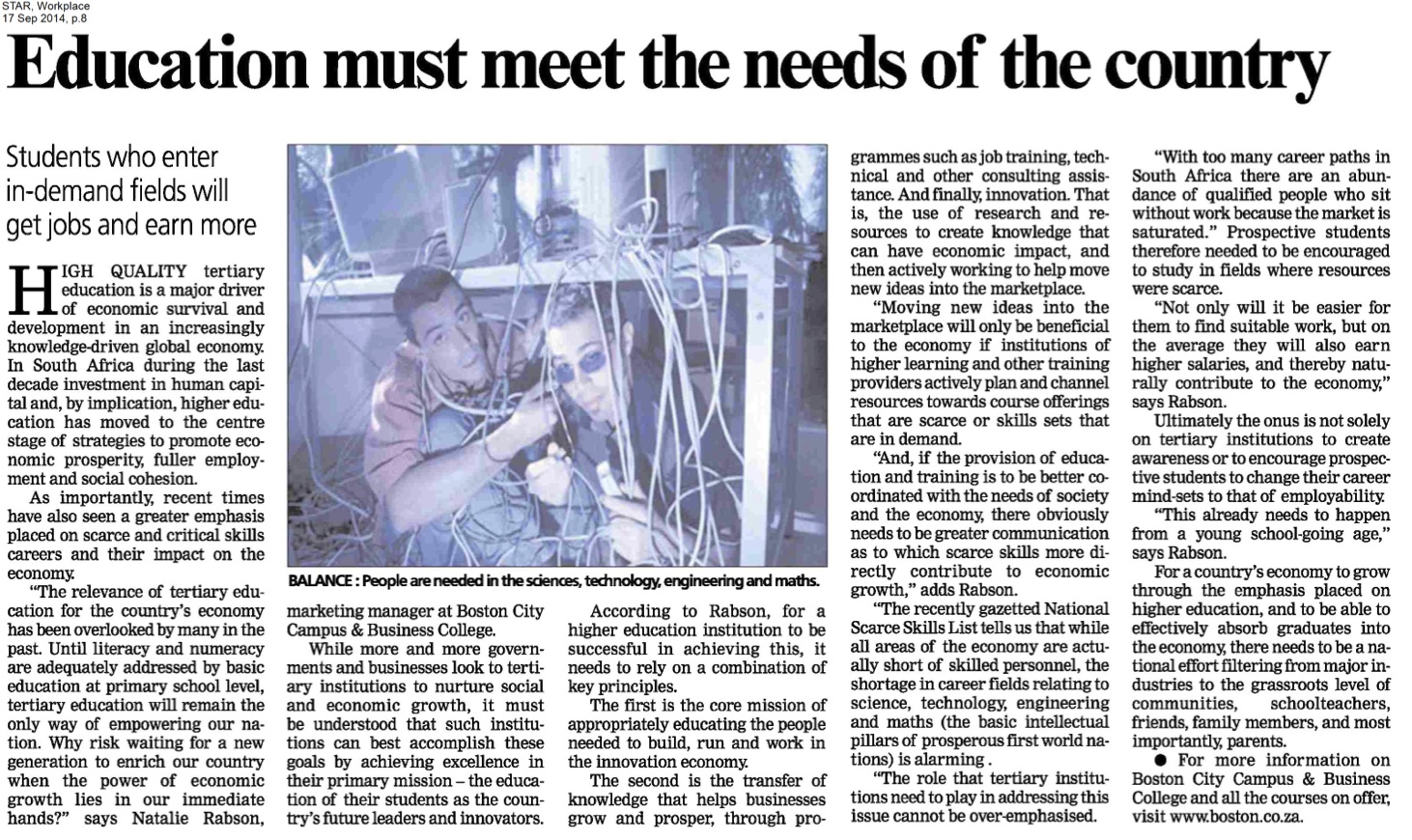
The recently gazetted National Scarce Skills List tells us that whilst all areas of the economy are actually short of skilled personnel, the shortage in career fields relating to science, technology, engineering and maths (the basic intellectual pillars of prosperous first world nations) is alarming . The role that tertiary institutions need to play in addressing this issue cannot be overemphasised. Besides creating appropriate course modules for careers for which there are too few qualified people, there has to be a shift in the way we promote such careers and the scarce skills they require.
“With too many career paths in South Africa there are an abundance of qualified people who sit without work because the market is saturated. This provides just another stimulus for our economic woes. Prospective students therefore have to be encouraged to consider studying towards careers in the scarce and critical skills fields. Not only will it be easier for them to find suitable work, but on the average they will also earn higher salaries, and thereby naturally contribute to the economy,” says Rabson.
Ultimately the onus is not solely on tertiary institutions to create awareness surrounding scarce skills fields, or to encourage prospective students to slightly change their career mind-sets for the benefit of employability.
This already needs to happen from a young school-going age. In fact, for a country’s economy to grow through the emphasis placed on higher education, and to be able to effectively absorb graduates into the economy, there needs to be a greater national awareness and effort – from all industries and sectors, filtering right down to the grassroots level of communities, school teachers, friends, family members, and most importantly, parents.
For more information on Boston City Campus & Business College and all the courses on offer, please visit www.boston.co.za
Students that apply for admission at Boston City Campus & Business College will get a response to their applications within two working days. And those that apply long in advance for their 2016 studie…
Read more »