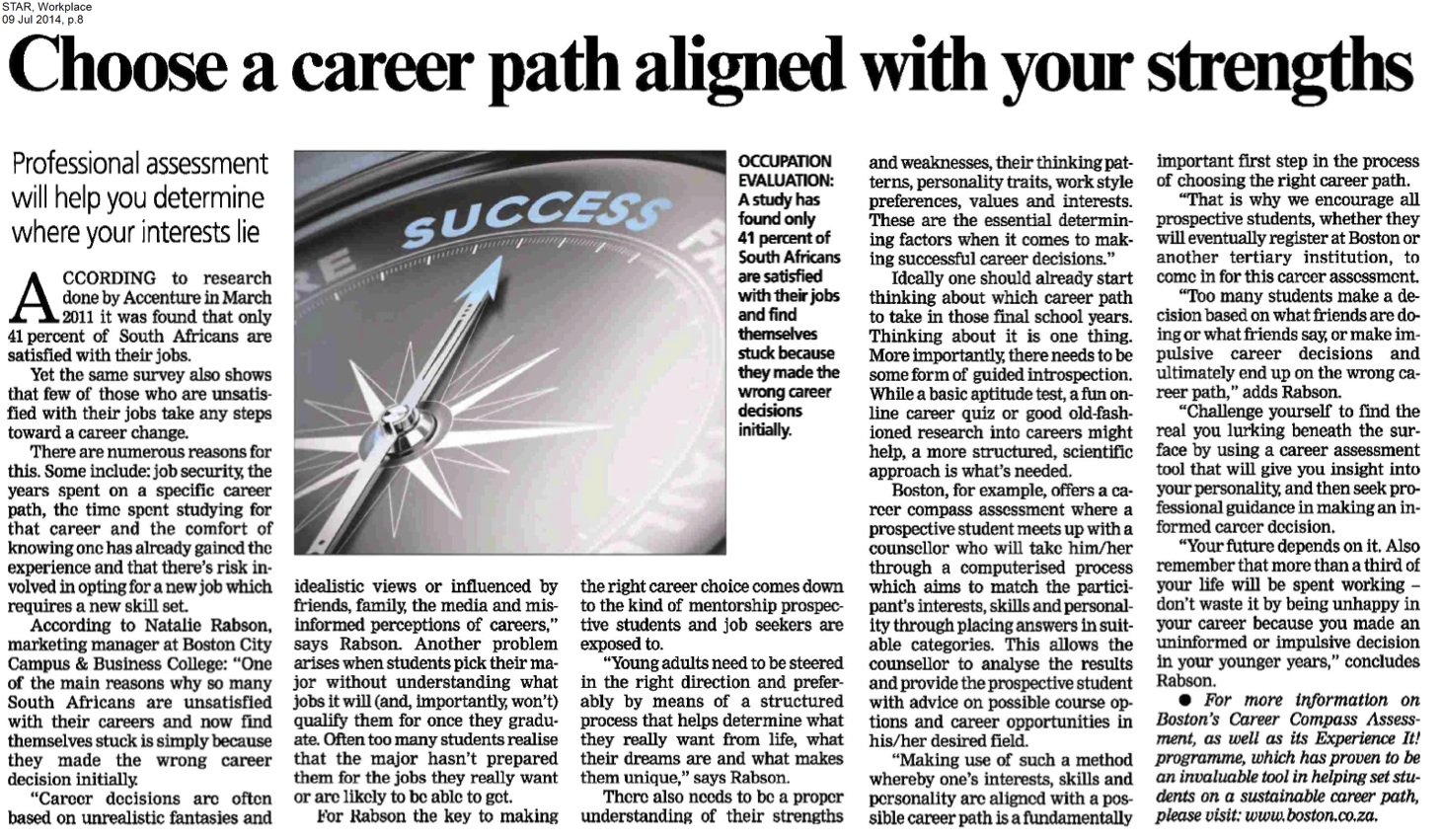
According to research done by Accenture in March 2011 it was found that only 41% of South Africans are actually satisfied with their jobs. Yet, the same survey also shows that very few of those who are unsatisfied with their jobs take any steps toward a career change.
There are numerous reasons for this, some include: job security, the years spent on a specific career path, the time spent studying for that career and the comfort of knowing one has already gained the experience and that there’s risk involved in opting for a new job which requires a new skill set.
According to Natalie Rabson, Marketing Manager at Boston City Campus & Business College “One of the main reasons why so many South Africans are unsatisfied with their careers and now find themselves stuck is simply because they made the wrong career decision initially.”
“Career decisions are often based on unrealistic fantasies and idealistic views or influenced by friends, family, the media and misinformed perceptions of careers,” says Rabson.
Another problem arises when students pick their major without understanding what jobs it will (and, importantly, won't) qualify them for once they graduate. Often too many students realise that the major hasn't prepared them for the jobs they really want or are likely to be able to get.
For Rabson the key to making the right career choice comes down to the kind of mentorship prospective students and job seekers are exposed to.
“Young adults need to be steered in the right direction and preferably by means of a structured process that helps determine what they really want from life, what their dreams are and what makes them unique. There also needs to be a proper understanding of their strengths and weaknesses, their thinking patterns, personality traits, work style preferences, values and interests. These are the essential determining factors when it comes to making successful career decisions,” says Rabson.
Ideally one should already start thinking about which career path to take in those final school years. Thinking about it is one thing; more importantly, there needs to be some form of guided introspection. Whilst a basic aptitude test, a fun online career quiz or good old fashioned research into careers might help, a more structured, scientific approach is in fact what’s needed.
Boston, for example, offers a career compass assessment where a prospective student meets up with a counsellor who will take him/her through a computerised process which aims to match the participant’s interests, skills and personality through placing answers in suitable categories. This allows the counsellor to analyse the results and provide the prospective student with advice on possible course options and career opportunities in his/her desired field.
“Making use of such a method whereby one’s interests, skills and personality are aligned with a possible career path is a fundamentally important first step in the process of choosing the right career path. That is why we encourage all prospective students, whether they will eventually register at Boston or another tertiary institution, to come in for this career assessment. Too many students make a decision based on what friends are doing or what friends say or make impulsive career decisions and ultimately end up on the wrong career path,” adds Rabson.
“Challenge yourself to find the real you lurking beneath the surface by using a career assessment tool that will give you insight into your personality, and then seek professional guidance in making an informed career decision. Your future depends on it. Also remember that more than a third of your life will be spent working – don’t waste it by being unhappy in your career because you made an uninformed or impulsive decision in your younger years,” concludes Rabson.
For more information on Boston’s Career Compass Assessment, as well as its Experience It! programme which has proven to be an invaluable tool in helping set students on a sustainable career path, please visit www.boston.co.za.
Students that apply for admission at Boston City Campus & Business College will get a response to their applications within two working days. And those that apply long in advance for their 2016 studie…
Read more »